
Search is changing quickly. For years, businesses have focused on Search Engine Optimization (SEO) to help their websites rank in Google and attract qualified visitors.
SEO still matters. But people are no longer only typing short keywords into Google and clicking through a list of links.
ChatGPT, Perplexity, Gemini, Copilot, virtual assistants, and Google’s AI-powered search experiences. Instead of simply showing websites, these tools often generate direct answers, summaries, recommendations, and comparisons.
That shift has introduced several new terms: AIO, AEO, and GEO.
They overlap, but understanding the differences can help your business make smarter decisions about how to show up in AI-driven search.
The short version
SEO, or Search Engine Optimization, improves a website so search engines can crawl it, understand it, and rank relevant pages in traditional search results.
AIO, or AI Optimization, is the broader strategy of helping AI (Artificial Intelligence) systems understand, trust, and recommend your business.
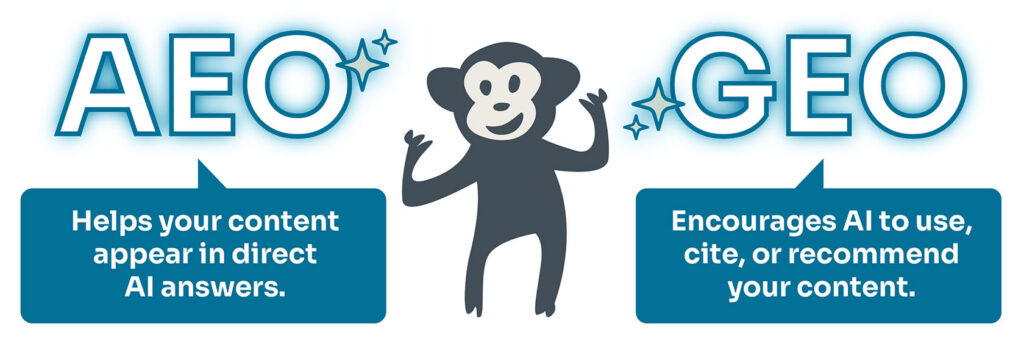
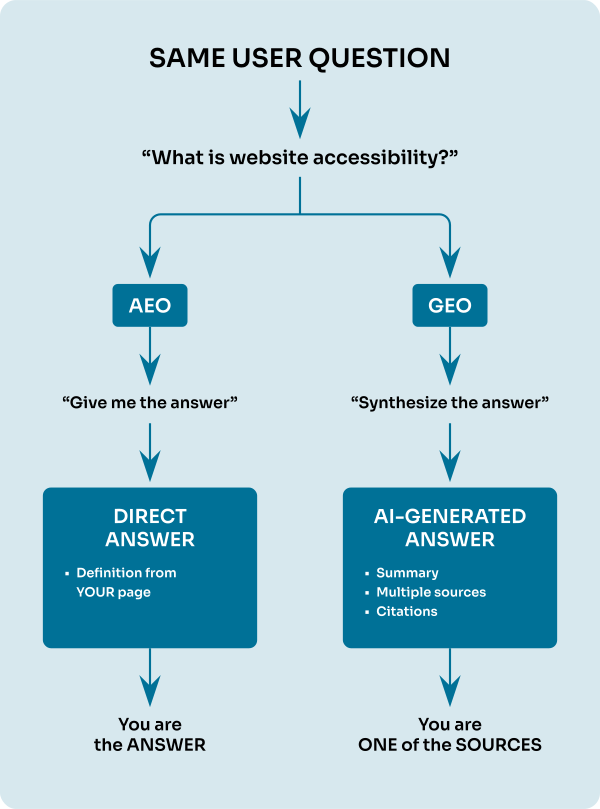
AEO, or Answer Engine Optimization, focuses on helping your content appear in direct answers.
GEO, or Generative Engine Optimization, focuses on helping your brand appear in AI-generated summaries, recommendations, and conversational responses.
At CodeGeek, we generally use AI Optimization as the umbrella term because it’s the clearest and most practical way to describe the work we do. AEO and GEO are important parts of that strategy, but the larger goal is simple: make your business easier to understand for both people and AI systems.
What is AIO?
AI Optimization improves your website and digital presence so AI tools can accurately understand who you are, what you offer, where you serve customers, and why your business is trustworthy.
AIO includes many familiar SEO fundamentals, such as:
- clear, helpful content
- strong page structure
- technical website health
- local SEO signals
- schema markup and structured data
- consistent business information
- service-specific content
- FAQs and answer-ready sections
- reviews, citations, and authority signals
The difference is the goal.
Traditional SEO often focuses on ranking pages in search results. AI Optimization focuses on making your business clear, credible, and usable as a source within AI-generated answers.
Your website needs to do more than include keywords. It needs to explain your services clearly, connect related topics, answer real customer questions, and provide enough structured context for AI systems to interpret your business correctly.
What is AEO?
Answer Engine Optimization helps your business show up when someone asks a direct question.
For example:
- “Who offers emergency plumbing in Fort Collins?”
- “What is the best dog boarding facility near Denver with outdoor play yards?”
- “How do I choose a WordPress web design agency?”
- “What does a managed website care plan include?”
In traditional search, the goal might be to rank for a keyword like “dog boarding Denver” or “WordPress web design agency.”
In answer-driven search, the query is often more conversational. The AI system may pull from multiple sources and generate a direct response. AEO helps your content become easier to extract, summarize, and cite in those responses.
When AEO works well, a concise answer from your website may be reflected closely in a featured snippet, Google AI result, voice response, or another direct-answer experience. The benefit is visibility at the exact moment a potential customer asks a question your business can answer.
Good AEO content is direct, well-structured, easy to summarize, written around real customer questions, and supported by clear service details and trust signals.
AEO does not mean stuffing pages with question-and-answer sections. It means organizing information so humans and machines can quickly understand the answer.
What is GEO?
Generative Engine Optimization focuses on visibility inside generative AI responses.
This matters because AI tools do not always return a single answer. Sometimes they generate a list, comparison, recommendation, explanation, or buying guide.
For example, a potential customer might ask:
“What are some reputable web design agencies in Colorado that specialize in WordPress and long-term website support?”
Or:
“Compare options for dog boarding near Denver that offer daycare, grooming, and trained staff.”
In these cases, the AI response may summarize several businesses and explain why each one is relevant. GEO increases the likelihood that your business is included, described accurately, and positioned appropriately.
GEO depends on more than one page of content. AI systems look for patterns across your website and the broader web. They need consistent signals about your services, expertise, location, reputation, and relevance.
Fun fact: A few years ago, just as ChatGPT was going mainstream, we prompted it to compare CodeGeek’s hosting service to other service providers like GoDaddy. Here were the results.
How SEO, AIO, AEO, and GEO work together
The easiest way to think about it is this:
- SEO helps you rank.
- AEO helps you answer.
- GEO helps you get included in generated responses.
- AIO brings it all together.
These are not isolated tactics. A business with weak SEO, unclear content, thin service pages, inconsistent location signals, or poor technical structure will also struggle with AI visibility.
AI Optimization builds on the same foundation that has always mattered: useful content, technical quality, authority, and trust. The difference is that content now needs to support traditional search, AI search, answer engines, and conversational tools.
Why this matters for businesses
AI-powered search changes how customers discover and evaluate businesses.
A customer may never search the exact phrase you optimized for. Instead, they may ask a detailed question based on their situation, preferences, location, budget, or urgency.
That means your website needs to answer more than “What do you do?”
It also needs to answer:
- Who do you serve?
- Where do you serve them?
- What makes your approach different?
- What problems do you solve?
- What should customers expect?
- What questions do customers ask before they contact you?
- What proof shows that your business is credible?
The clearer those answers are, the easier it becomes for AI systems to understand and reference your business.
What optimizing for AI looks like in practice
AIO starts with a website and content audit. We look at whether your site clearly communicates your services, service areas, expertise, and trust signals.
We also review how your content is structured, whether important information is buried, and whether search engines and AI tools can interpret your pages correctly.
From there, AIO may include the following in addition to the traditional SEO fundamentals described above:
- clarifying relationships between services, locations, expertise, and related entities
- adding content around common customer questions and decision criteria
- testing how your business appears in AI tools
- monitoring whether AI-generated descriptions are accurate and supported by your website
- strengthening third-party citations, reviews, and authority signals
The goal is not to trick AI. The goal is to make your business easier for AI to understand, verify, and recommend.
Does AIO replace SEO?
No. AI Optimization does not replace SEO. It expands it.
Search engines still need to crawl, index, and understand your website. Customers still use traditional search results. Rankings, technical performance, content quality, and authority still matter.
But AI-driven search adds another layer. Your content now needs to be useful not only as a webpage someone might click, but also as a source that AI systems can interpret and summarize.
Businesses with a strong SEO foundation are often in the best position to benefit from AI Optimization. Businesses with outdated, thin, or poorly structured websites may need to strengthen the basics first.
An SEO vs. AIO example
Imagine a business that offers dog boarding, daycare, grooming, and training.
A traditional SEO approach might focus on terms like:
- Dog boarding Denver
- Dog daycare Denver
- Dog grooming near me
- Puppy training Denver
An AI Optimization approach goes further by making sure AI systems can understand details such as:
- “The business offers multiple pet care services.”
- “The services are connected but distinct.”
- “The business serves a specific geographic area.”
- “Staff have relevant training or certifications.”
- “The facility offers specific amenities.”
- “Customers commonly ask certain questions before booking.”
- “Reviews and reputation support the business’ claims.”
That richer context makes the business more likely to appear in relevant AI-generated answers, especially when users ask detailed questions.
The bottom line
AIO, AEO, and GEO are different ways of describing the same major shift: search is becoming more conversational, AI-assisted, and answer-driven.
For businesses, the opportunity is clear.
Websites need to be built and written in a way that helps both people and AI systems understand the business quickly and accurately. That means clear content, strong structure, technical quality, schema markup, entity clarity, and trustworthy supporting signals.
AI Optimization captures the bigger picture. It is not about chasing acronyms. It is about helping your business stay visible as search evolves.
If your website was built for yesterday’s search experience, now is the time to prepare it for how people are searching today—and how they will search tomorrow.