

Attracting potential customers to your website is easier than you may think. With all the data gathering and customer journeys and more, it can feel like grabbing a visitor’s attention is akin to rocket science.
While we do spend way too much time thinking about rockets and space stuff (heck, even our Head Geek used to be a nuclear physicist), our goal is always to break down complex ideas into super practical to-dos.
We’re web designers and developers, not marketers, so we’ll let the pros speak deep into marketing strategy. However, we have learned a thing or two about attracting the right people to your site during the more than 20 years of building beautiful and highly usable websites and apps.
Keep reading for our top three tips (from a web dev perspective) for attracting customers to your website—and keeping them there. ✨
1. Make your website about your customers, not yourself.
Be education focused.
Often, when companies are developing their websites, they think of them primarily as advertisements for their services. However, the best way to attract visitors to your site (and have them stay once they’ve found you) is to ensure that your content and images address their needs, not your ego.
You don’t want to brag about how great your business is. You want to draw visitors in and show them how your services can benefit them. Another way to look at it is to shift your focus from being interesting, to being interested.
When considering your site’s design and content, ask yourself, “What do my customers want to know?” Change your perspective from one of selling to one of educating.
This principle sounds simple, but it takes discipline—and time—to execute well.
Provide content that solves problems.
When our team of Geeks develops a website, we spend anywhere from 4 to 12 weeks in discovery, planning, and content collaboration before a site ever moves into development.
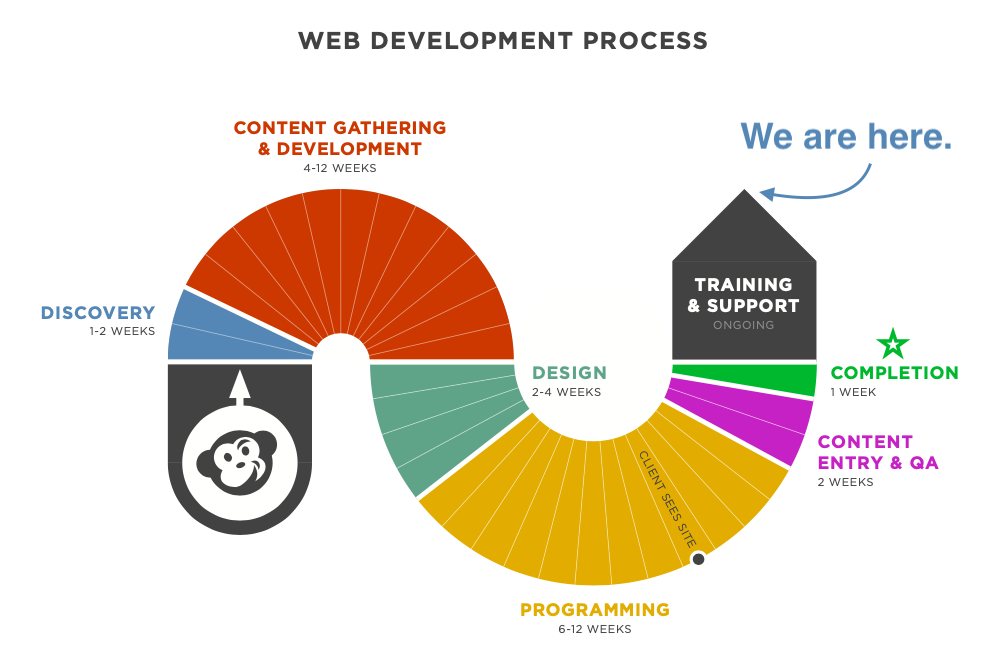
We use that time to better understand:
- who the site is for
- what problems those users are trying to solve
- what questions they need answered to move forward
And images are also important! Visuals shouldn’t be decorative filler. They should reinforce clarity, context, and trust.
If your website focuses on the user’s needs, your site content will feel relevant. And relevance is what keeps potential clients reading, scrolling, and engaging.
Shift your focus from being interesting, to being interested.
2. Keep your website (and its tech) up to date.
A website is not a “set it and forget it” asset. Businesses evolve. Services change. Teams grow. If your website doesn’t reflect reality, visitors will notice.
Reflect reality.
It’s important to make sure your website accurately represents your business plan and stays in sync with it. The digital face of your business should be a truthful reflection of your business and its offerings. When serving the customer, you want to be able to back up all that’s being promoted on your website.
From a content standpoint, this means:
- Your website should be built on a platform your team can reasonably update, such as WordPress (like our site) or Webflow (like the site we built for Redball Energy). You shouldn’t need a developer every time you want to fix a typo, add a new service, or update a blog post.
- We also recommend revisiting your own website often to make sure your content is as up to date as possible. This is your chance to confirm your messaging and services reflect your business, blog posts remain relevant, and that links and images aren’t broken.
Function as expected.
However, content updates are only half the equation. From a technical perspective, it’s equally important that the site itself is kept up to date. This includes:
- core platform updates
- plugin updates
- performance optimizations
- security patches
Outdated software doesn’t just pose a security risk—it can degrade performance, accessibility, and compatibility over time. That’s why ongoing maintenance and update plans are a core part of how we approach long-term website health, and not as an afterthought.
Up-to-date websites load more reliably, function more predictably, and better support modern browsers, devices, and assistive technologies. And all of this contributes to a smoother experience for users.
Your website should be a truthful reflection of your business.
3. Make your site usable and accessible.
Design for maximum usability.
It’s important to ensure your website’s design is user-centered. This means that the site accurately services the visitors, and that visitors can easily navigate through your website. This is a simple, yet important factor in website development.
You may have a beautiful site design with a lot of useful content, but if the site layout is such that visitors can’t easily flow through the site and find what they want, your website won’t thrive.
Be accessible from the start.
User-centered design also means acknowledging that not all users experience the web the same way. Accessibility is a critical (and too often overlooked or dismissed) part of usability.
Making your website accessible means ensuring it can be used by people with visual, auditory, motor, or cognitive disabilities, as well as by users on older devices, slow connections, or assistive technologies.
Practically speaking, web accessibility includes details such as:
- clear semantic structure so screen readers can interpret content correctly
- sufficient color contrast and readable typography
- full keyboard navigation
- thoughtful image alt text that provides meaningful context
Pro tip: See how the above considerations make a difference and learn more about accessibility with our interactive Accessibility Adventure.
Accessibility isn’t about checking boxes or meeting minimum requirements. Accessibility is about removing unnecessary friction so more people can successfully use your site.
Websites that are easy to navigate, understand, and interact with naturally serve a wider audience—and a wider audience means more opportunities for connection.
A wider audience means more opportunities for connection.
Attraction is about fundamentals.
Attracting customers can be easier than it sounds. The best thing to keep in mind is to always think in terms of what your clients want to see and need to know. Also important to remember is to deliver a quality product, be truthful, and educate the client when anticipating their needs.
These principles may not be rocket science, but they do rely on fundamentals. Ignore them, and things fall apart. Get them right, and everything else becomes easier and better—for everyone.
Deliver a quality product, be truthful, and educate.
Rocket image credit: Roland Horváth on Unsplash